
Granola Is Growing Without a Big Editorial Engine. Can That Last?
- Jeremiah Ajayi
- 15 minutes ago
- 8 min read


Granola gets an estimated 19.1K monthly organic visits from a remarkably small search footprint. About 88% of that traffic lands on the homepage, while the company ranks for 91 keywords and maintains a relatively small editorial estate.

Yet the product is growing quickly. In Ramp’s customer data, Granola ranks #2 for adoption in Sales Execution & Orchestration, with adoption up 21 percentage points year over year. It also ranks first for both new adopters and competitor switching.

That combination caught my attention. If Granola is gaining users without building the kind of large search and editorial machine common among competitors such as Otter and Fireflies, something else has to be creating the demand.
So I traced the system from its early VC wedge through onboarding, lifecycle emails, product launches, partnerships, search and AI discovery. The question became less whether Granola uses content and more interesting: what does content do when the product and its users create much of the pull?
Methodology
I audited Granola, Otter, Fireflies and Fathom in Ahrefs on 2 September 2026 using the same US database, comparing estimated organic traffic, top pages, homepage share and organic keywords. I then ran six buyer-style queries in Perplexity: four neutral category prompts and two Granola comparisons, recording inclusion, positioning and visible sources. These are directional point-in-time signals rather than market-share or causal measures. The Ramp figures cited earlier come from activity within Ramp’s own procurement and renewals dataset, so I use them as an adoption signal rather than a measure of the entire market.
The VC wedge made word of mouth intentional
Granola’s demand did not begin with a broad acquisition play. Its first users were venture capitalists, a deliberately narrow group chosen partly because of how much distribution each user could create.
Chris Pedregal has explained that VCs were attractive because they had frequent, fairly predictable meetings and were easy for the early team to reach. More importantly, those meetings connected Granola to founders, executives and other investors. One useful user could expose the product to several potential users through work they were doing anyway.
That distribution widened as the product grew. Founders adopted it, leadership teams followed, and by Series A, 57% of users were reportedly in leadership positions. Collaboration then gave the loop another route: shared meeting notes could land in Slack, where colleagues encountered Granola’s output before ever using the product themselves.
Granola’s current product keeps pushing in the same direction. “Invite teammates” and “Team up for free” turn an individual user into a potential distribution channel, while the pricing model increasingly rewards team adoption.

That helps explain the search data. Ahrefs estimates roughly 23,100 monthly organic visits to Granola, with about 20,600 going to the homepage. Someone searching for Granola may have first encountered it in a meeting, through a colleague, in a shared note or via someone they trust.
If much of the awareness is created before the search happens, then the blog is probably the wrong place to look for Granola’s content strategy.
So what is content doing?
Granola’s content becomes easier to understand when you follow what happens after someone encounters the product.
The first clue appears during signup. Granola asks users how they heard about it, offering options including friend or colleague, Reddit, LinkedIn, AI chat, podcasts, events, newsletters and articles. Those channels mirror the wider system around the product: recommendations, communities, founder-led media, events and editorial discovery.

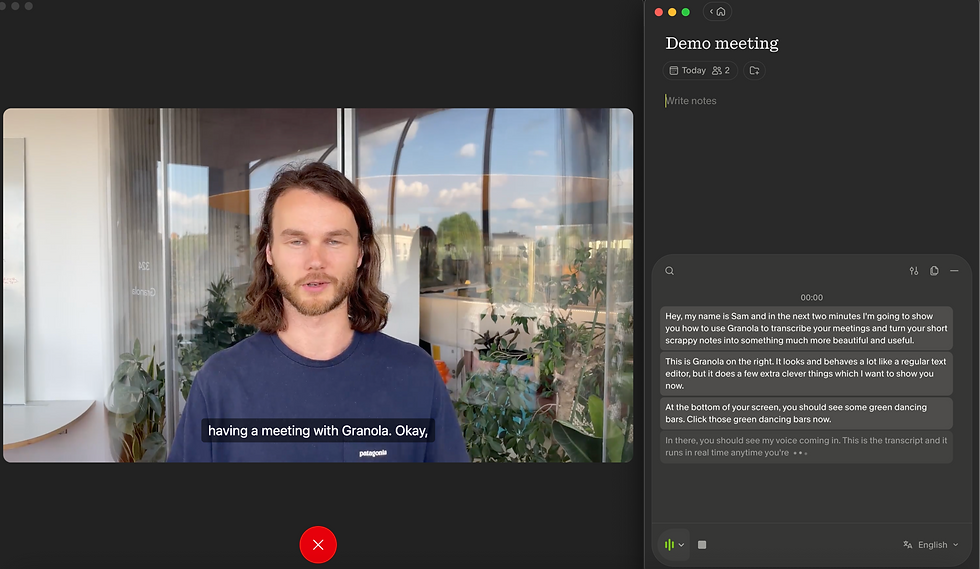
Once someone gets in, Granola does not send them to a getting-started article. It creates a demo meeting with Sam Stephenson.
As Sam explains how Granola works, the product transcribes the conversation, asks the user to write deliberately rough notes and then improves those notes in front of them. The tutorial and the product demonstration are the same experience. By the time onboarding ends, the user has seen the core value rather than merely read about it.
Email takes over from there. The welcome message organizes Granola around the actual meeting workflow: what to do before a meeting, what happens during it and what becomes possible afterwards. Subsequent emails introduce Chat, folders, templates, follow-ups, meeting history and integrations as those capabilities become relevant.

Expansion gets its own content layer. Inside the product, prompts such as “Invite teammates” and “Team up for free” appear alongside the value of collaboration. The Business trial explains longer meeting history, stronger models and integrations at the point where an individual user can start bringing colleagues in. The copy is doing commercial work inside the product loop: moving the user from this helps me towards this could help my team.


Granola then turns what it ships into material for distribution. Its recent social activity is dominated by things people can use or experience: MCP integrations, templates, follow-up workflows, Delphi, the Apple Watch app and new product capabilities.


Granola also extends product distribution through partnerships, events and physical launches. Its Apple Watch strap, for example, gave existing users a tangible product moment to share, while firesides and community events put Granola in front of the same founder and operator networks that drive word of mouth. These reinforce a growth system that relies heavily on user advocacy and network effects.

That explains how content works inside Granola’s growth system. It still leaves a harder question: is Granola genuinely unusual, or is the whole category more brand-led than it looks?
Granola's search footprint is compact, but homepage concentration isn't unique
Granola’s search footprint is heavily concentrated around the product.
Ahrefs estimates 19.1K monthly organic visits, with 16,758 — 87.5% — going to the homepage. Pricing adds another 674 visits, while Explore and AI Note Taker contribute 389 and 378 respectively. The largest blog pages reach a few hundred visits each.
The competitor comparison changes how I interpret that concentration.
Otter is even more homepage-heavy: 91.3% of its estimated 186.4K organic traffic lands there, despite the domain ranking for roughly 2,100 keywords.

Fathom’s homepage accounts for 45.2%, but another 42.7% goes to /Overview, putting almost 88% of its traffic across two product-facing pages.

Fireflies takes a different route. Its homepage captures 67% of estimated traffic, with the rest spread across pricing, help content and hundreds of editorial pages covering meeting templates, integrations and adjacent workplace queries. It ranks for roughly 1,400 keywords across 344 pages.
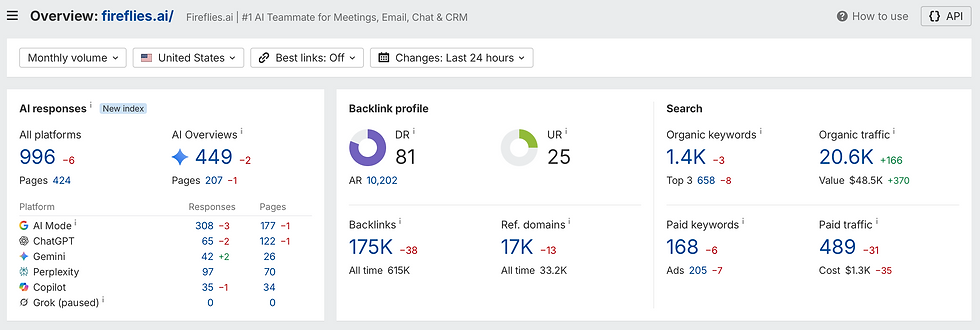
Granola reaches almost the same estimated traffic — 19.1K versus Fireflies’ 20.5K — with 34 pages and 91 keywords.
There is a trade-off, though. Ahrefs records 141 AI responses for Granola, compared with 200 for Fathom, 996 for Fireflies and 1,800 for Otter. Those figures do not tell us whether Granola is recommended for the right queries, but they do show how much larger the competitors’ retrievable footprints are.
Search tells us Granola can capture substantial demand without matching its competitors page for page. It still leaves the harder question: what happens when the buyer does not know which brand to search for?
What happens when Granola’s name disappears from the query?
I tested that question in Perplexity on 2 September 2026 using four neutral buyer queries:
“best AI meeting notes app”
“What are the best AI meeting assistants for startups?”
“What are the best meeting intelligence tools for teams?”
“What are the best AI meeting tools for enterprise teams?”
I also ran “Granola vs Otter: which is better?” and “Granola vs Fireflies: which is better?” to see what evidence Perplexity used once Granola entered an active evaluation. This was a directional test of one answer engine, rather than a representative measure of AI-search visibility.
Granola performed strongest at the individual end of the buying journey. For “best AI meeting notes app,” Perplexity made it the strongest general recommendation, emphasizing its bot-free experience and combination of manual notes with automatic transcription.

That advantage became less pronounced when I asked “What are the best AI meeting assistants for startups?” Granola remained one of five prominent options, but Fathom, Fireflies, Otter and tl;dv appeared before it. Perplexity continued to associate Granola with bot-free, privacy-friendly meetings rather than broader team automation.

The positioning narrowed further with “What are the best meeting intelligence tools for teams?” Fireflies became Perplexity’s recommendation for broad team-wide intelligence. Granola was still included, but specifically for privacy-sensitive teams that dislike meeting bots, with a caution that it was less suited to a central enterprise conversation database or deep organisation-wide analytics.

The enterprise query makes the boundary clearest. For “What are the best AI meeting tools for enterprise teams?”, Microsoft, Zoom and Google led the answer, followed by standalone products including Otter and Fireflies. Granola appeared further down in a group with Fathom, tl;dv and Avoma as the evaluation criteria shifted towards SSO, retention controls, administration, data residency and governance.

The two direct comparisons expose another part of the content system. When I asked “Granola vs Otter: which is better?”, Perplexity had a clear understanding of Granola’s differentiation, but much of the evidence explaining that differentiation came from independent reviewers such as Zack Proser and Mrkt Correct.
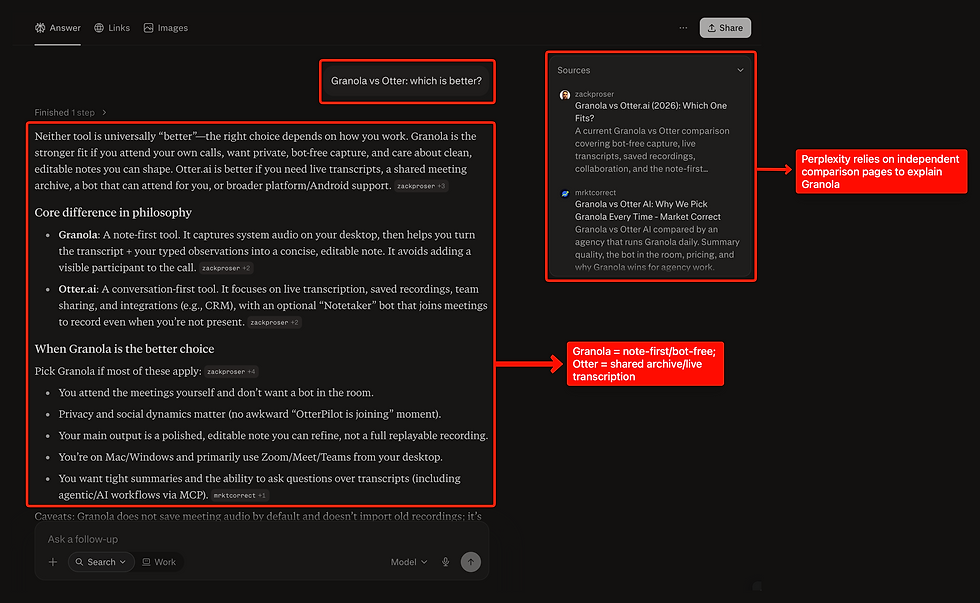
The Fireflies comparison makes the contrast more pronounced. Third-party reviews again helped explain Granola, while Fireflies’ own comparison content appeared among Perplexity’s sources. In other words, Granola is earning recommendation without publishing a large comparison estate of its own, but competitors have more opportunities to participate directly in how the category explains them.

The issue, then, is not whether Granola can be discovered. It clearly can. The pressure point appears when the buyer moves from an individual who values a great note-taking experience to a team or enterprise buyer who needs evidence for governance, administration and organisation-wide use.
Where Granola could strengthen the model
Own more of the evaluation layer
Granola performs well when Perplexity is helping an individual choose a note-taking app, but third-party reviewers do a lot of the work when buyers compare it directly with Otter or Fireflies. Granola could publish stronger comparison, migration and use-case pages that give buyers—and answer engines—first-party evidence without turning its strategy into a high-volume SEO program.
Build content for the buyer Granola is growing into
The Perplexity test weakens as the query moves from individuals to teams and enterprise buyers. That creates a more specific content requirement: security documentation, administrative controls, deployment guidance, ROI evidence, customer proof and material designed for IT, security, finance and procurement. The individual champion can introduce Granola; these assets help that champion finish the sale.
Create more citable category evidence
Granola has plenty of product storytelling, but relatively little material that establishes how its approach compares with the category around it. Customer research, benchmarks, implementation evidence and technical explainers could give third parties and answer engines stronger material to cite without requiring Granola to become an editorial publisher at Fireflies’ scale.
What content teams should take from this
If most organic traffic lands on your homepage, stop treating the blog as your main acquisition engine. Granola gets roughly 88% of its estimated organic traffic through the homepage. In that situation, the first question is not “what should we publish next?” but “what is creating enough awareness for people to search for us by name?” Content investment should reinforce that source of demand.
If champions are bringing in the next user, build for the next person they need to convince. Granola’s product makes individual adoption easy, but the buying context changes as usage spreads across a company. The content required for a founder recommending Granola to a colleague is different from what security, finance or procurement will need before approving wider rollout.
If launches and product moments travel further than evergreen editorial, resource them accordingly. Granola repeatedly turns features, integrations, partnerships and physical activations into distribution. For teams seeing the same behaviour, product marketing, lifecycle content and launch creative may deserve more attention than maintaining a high-volume SEO calendar.
Test discovery without your brand name. Branded traffic can make visibility look healthier than it is. Run neutral category searches and AI prompts to see whether your company still enters the consideration set when the buyer has not supplied the name. Granola passed that test for individual use, but its position weakened as the query moved towards team and enterprise buying.


Comments