
Best Savings Apps in Nigeria According to ChatGPT, Gemini & Perplexity

Updated: Aug 12

A Nigerian trying to save money today may still start with Google. They may also ask ChatGPT, Gemini or Perplexity a question like: “What are the best savings apps in Nigeria?” or “Which fintech apps are most trusted for saving and investing money?”
That behaviour is becoming easier to imagine because AI use keeps moving into everyday life. In a 2026 Google/Ipsos survey across 21 countries, two in three respondents said they had used an AI tool or application in the past 12 months, and Nigeria was one of the countries surveyed.
I wanted to see how this plays out in a Nigerian category, so I tested five questions about saving and investing across ChatGPT, Gemini and Perplexity.
What I tested
Prompt label | Full prompt |
Best savings apps | What are the best savings apps in Nigeria? |
Dollar savings apps | What are the best apps for saving dollars in Nigeria? |
Safest fintech apps | What are the safest fintech apps for saving money in Nigeria? |
Automation + discipline | Which Nigerian fintech apps help people automate savings and build financial discipline? |
Most trusted saving/investing apps | Which fintech apps in Nigeria are most trusted for saving and investing money? |
For each answer, I recorded which companies appeared, how they were described, the buyer use case attached to them and the sources shown by the tool.
The test was run on August 7, 2026. AI answers can change between searches, so the results capture what appeared during this test rather than a permanent ranking.
Finding 1: PiggyVest owns savings discipline
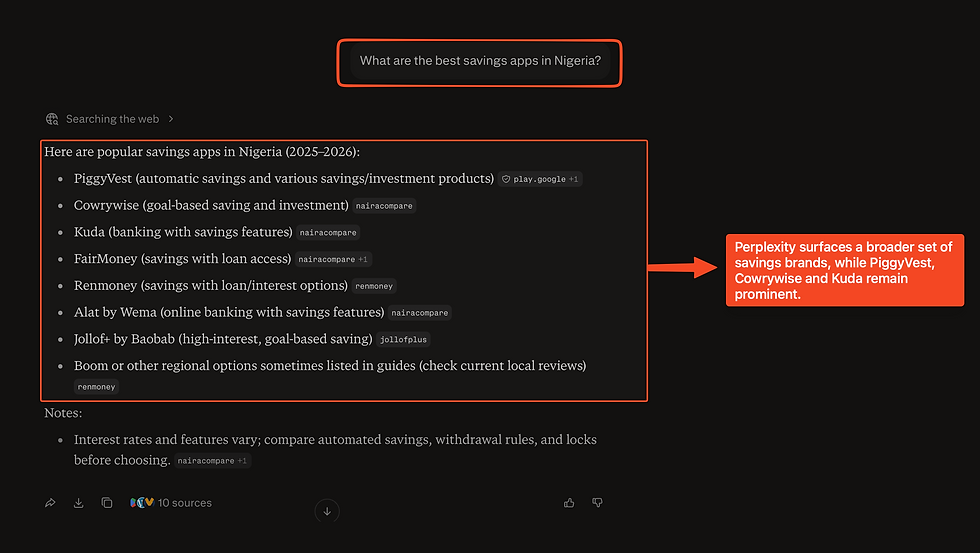
PiggyVest appeared in 14 of the 15 answers. Its strongest pattern came from the language attached to the brand.
ChatGPT described PiggyVest as best for automated, disciplined saving. It pointed to automatic savings, SafeLock and goal-based saving, then chose PiggyVest as its best overall option for disciplined saving.

Gemini gave PiggyVest a similar role. Its general savings answer placed it first for disciplined and goal-based saving, while the automation prompt connected the brand to AutoSave, SafeLock and Target Savings.

Perplexity also chose PiggyVest as its best overall option for financial discipline and described it as suitable for people who need structure around withdrawals.
Finding 2: Cowrywise owns structured saving and investing
Cowrywise also appeared in 14 of the 15 answers, with a different association.
ChatGPT described it around saving plus investing, including automated deposits and mutual funds. Gemini linked Cowrywise with long-term wealth building, automated saving and SEC-regulated investment products. Its trust answer also drew attention to financial education and the company's investment-led approach.
Perplexity described Cowrywise as suitable for people who want savings and mutual funds, with automated saving connected to professionally managed investment products.
Finding 3: ChatGPT, Gemini and Perplexity recommend different apps for dollar savings
The dollar-savings prompt gave me the widest variation in the entire test.
ChatGPT interpreted “saving in dollars” around holding foreign currency, receiving international income and growing money in dollar assets. It recommended Grey and Raenest alongside Risevest and Bamboo, then brought traditional domiciliary accounts from GTBank, Access Bank, UBA and Zenith into the answer.

Gemini read the same question differently. Its recommendations were PiggyVest, Cowrywise, Risevest and Bamboo. The answer focused on Flex Dollar, dollar-denominated mutual funds and investment products.

Perplexity produced another group: PiggyVest, Cowrywise, Rise, Muna, Pillow Fund, Bamboo and Geegpay.

Kuda appeared in 12 of the 15 answers overall, yet none of the three tools recommended it for dollar savings. Grey appeared only once in the entire audit, but ChatGPT placed it first for this particular question.
A marketer can therefore get a poor picture of the market by tracking one broad category prompt. Buyer language affects which companies enter the answer, and AI tools can interpret the same language differently.
Finding 4: Safety prompts favoured bank-backed and regulator-verifiable brands
Safety produced another shift.
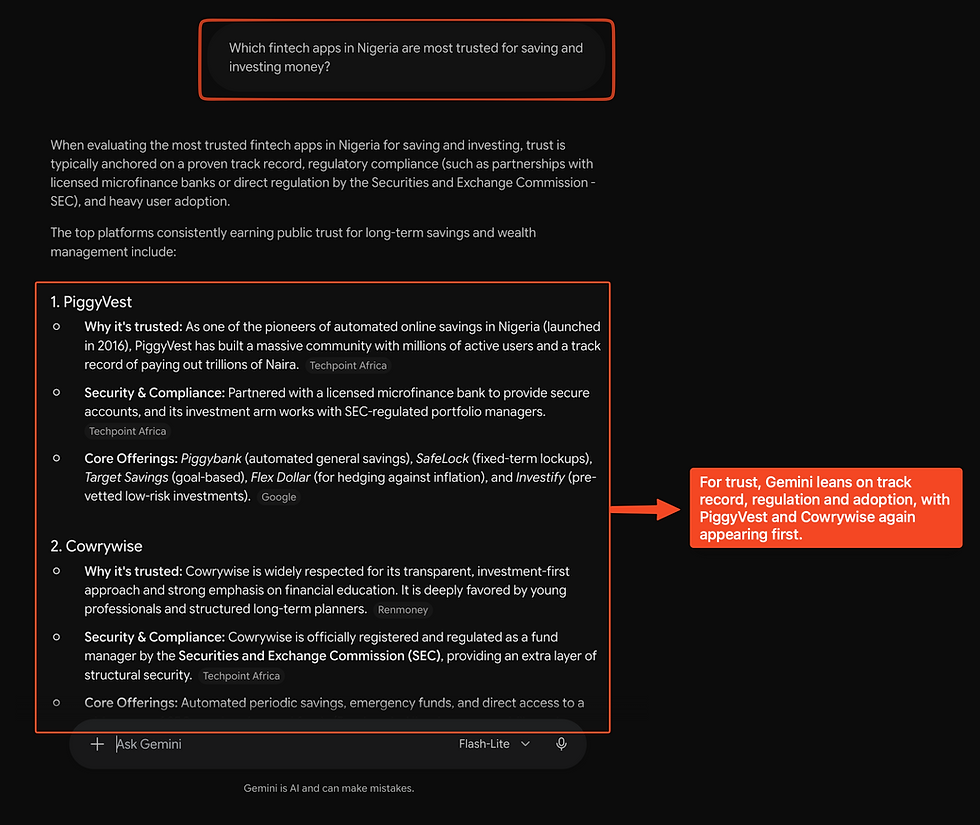
Gemini organised its answer around regulatory structure. Kuda, FairMoney and Carbon were discussed as directly licensed digital banks, with CBN licensing and NDIC insurance playing a large role in the explanation. PiggyVest and Cowrywise appeared under dedicated savings and wealth platforms, where partner institutions, trustees and SEC oversight received more attention.
Perplexity took a similar regulatory approach. Kuda and ALAT appeared first, followed by Moniepoint, PiggyVest and Cowrywise, with Renmoney and FairMoney also included. Its answer spent time explaining NDIC protection, SEC registration and the difference between deposits and investment products.

ChatGPT used regulation, operating history and security practices as its criteria, although PiggyVest remained its overall recommendation. Kuda's licence and ALAT's relationship with Wema Bank featured in their descriptions.
When a buyer introduces safety into the question, evidence about licences, insurance, custody and regulatory status receives much more attention. Product features carry less of the answer than they do in the savings-discipline prompts.
Finding 5: Sources shaped the answers
The source lists helped explain how differently these answers were assembled.
Gemini often relied heavily on a small group of pages. Its automation answer repeatedly referenced Renmoney's Best Savings Apps in Nigeria article when discussing PiggyVest, Kuda, FairMoney and Renmoney itself. Google Play supplied product information about PiggyVest and Cowrywise, while nairaCompare appeared around Cowrywise and Kuda.
Its dollar-savings answer was even more concentrated. Condia supplied much of the information Gemini showed around PiggyVest, Risevest and Bamboo. Cowrywise's Google Play listing supplied another part of the answer.
This gives marketers a useful example of how public category content travels. Renmoney is a participant in the market, yet Gemini used Renmoney's comparison article while explaining several competing products.
Perplexity used a broader set of publishers for dollar savings, including TechCabal, BusinessDay, Condia and other comparison pages. For safety, its source list moved heavily toward SEC, NDIC and CBN pages. Its automation answer also included first-party pages from PiggyVest, Cowrywise and Kuda.
ChatGPT surfaced a different source list. Its general savings answer included Money.ng, Brands.ng, NaijaSabi and MoneyX, along with pages focused on budgeting and dollar accounts. The dollar-savings answer is a useful caution when reading ChatGPT's sources: Grey and Raenest led the response, while much of the surfaced source list focused on PiggyVest, Cowrywise, Kuda and general savings comparisons. The connection between a surfaced source and an individual recommendation was not always visible.
So I would avoid treating source counts across the three tools as directly comparable. Each product exposes its evidence differently.
What marketers can do with this
Start with buyer questions
Build a small set of questions around the situations that lead customers toward your product.
A payroll company could test how founders ask about paying contractors. A Lagos logistics company could test questions from Instagram vendors looking for reliable delivery. A skincare company could track questions around acne-prone skin or hyperpigmentation.
Run the questions across the tools your customers are likely to use and save the answers.
Record the description around your brand
Track the words that appear beside your company. Include the use case, the recommendation language and the other companies in the answer.
Compare those descriptions with the language on your website and product pages. An old product description or an unexpected association is worth investigating even when the brand appears frequently.
Check the sources behind the answer
After every test, check the source list. Are the sources current? Are they credible? Do they describe your brand well? Are they mostly about your competitor?
That source layer may explain why one brand keeps showing up while another brand barely appears.
Fix the public language around your brand
Your homepage, product pages, help docs, app store description, customer stories, comparison pages and media mentions should repeat the use case you want to own.
If you help SMEs pay contractors, say it in plain English. If you help vendors deliver orders across Lagos, make that easy to find. If your product helps people save without touching the money, name that behaviour everywhere buyers and AI tools may look.
Build proof outside your website
AI tools learn from more than your own pages. Comparison articles, app store pages, reviews, interviews, partner pages, customer stories, regulator pages and media mentions can shape how your brand appears.
A good product page helps. Public proof from other places helps even more, especially when those sources describe your brand with the same words you want buyers to remember.
Inspect the cited pages
Open the sources and record who published them.
Look closely at comparison pages, regulator sites, app-store listings and competitor-owned articles. If a source gets facts about your company wrong, you have something concrete to investigate. If a competitor's comparison page keeps appearing, read how it describes the category and which claims the AI tool picks up from it.
Start manually and automate when the prompt set grows
A Google Sheet works well for an initial audit. Running the same questions every month also gives you a baseline before adding another tool.
Platforms such as Profound can automate this when the workload grows. Profound says its Prompt Tracking product can run prompts daily and report brand appearance, relative rank, share of voice and citation data across AI platforms. Its Prompt Volumes product uses anonymised prompt data from ChatGPT, Gemini, Claude and Perplexity to help teams find questions worth tracking. Regional coverage varies, and Profound says its demographic coverage is strongest in the US, UK and selected European markets, so Nigerian teams should check the available local data before using volume estimates to choose prompts.
Want to Run This for Your Company?
This is the audit we’ll run inside my AI-era Discovery Sprint with Treford.
You’ll test your own company across ChatGPT, Gemini, Perplexity and other buyer discovery channels, then identify where competitors are being recommended ahead of you and what you need to fix.
By the end, you’ll have a prompt tracker, competitor analysis, content gap list, citation gap list and a 90-day plan for improving brand recognition and customer acquisition.
A seat costs ₦150,000 (or $150 if you're abroad).
Register here: https://luma.com/r80fv07g


Comments